

Feeling lonely is one of the most common and emotionally draining experiences we all struggle with. As a result, too many of us often feel suffocated and imprisoned in our own worlds.
You don’t have to be alone to feel lonely; it can happen even while surrounded by family and friends. Loneliness isn’t just physical isolation in your room; it’s the emotional disconnection that makes you feel misunderstood, unseen or unsupported.
Why do I feel lonely?
Loneliness doesn’t come suddenly. It builds up gradually through our own deliberate actions. It usually starts when we consistently spend a lot of our time doing things that don’t require another person’s involvement. This leads to a lifestyle where “emotional connection” becomes optional, and eventually, rare.
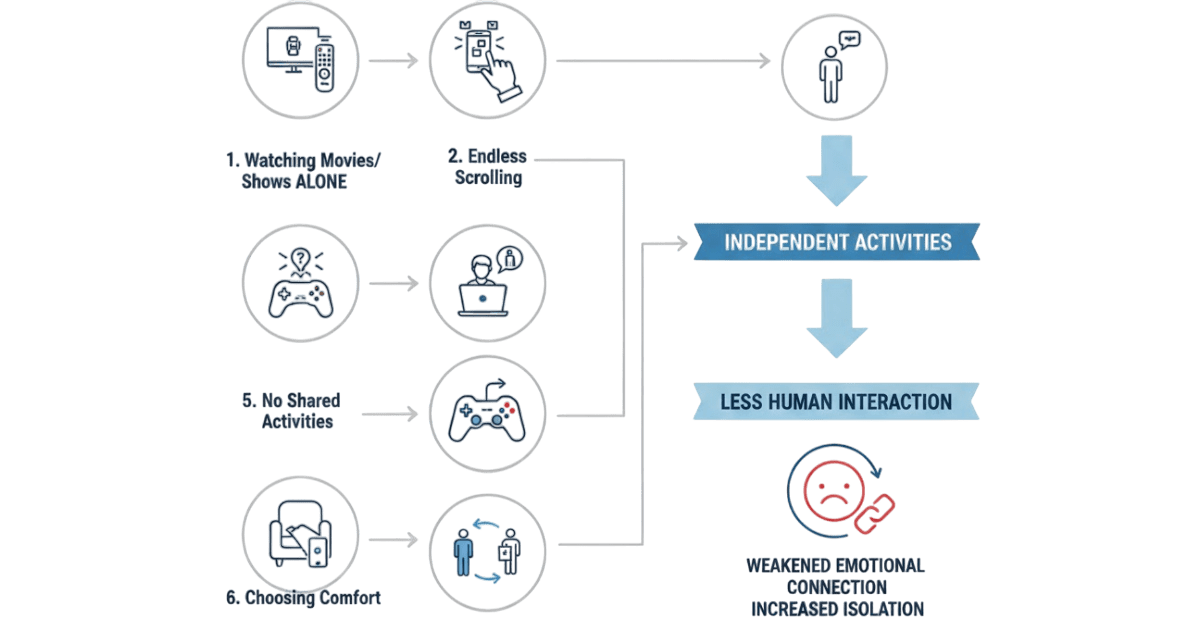
As we keep engaging in “independent activities“, our dependency on others reduces along without our sense of connection, warmth and human presence.
These are the common habits that unintentionally build up loneliness in us:
- Watching movies or shows alone in your room on consistent basis
This creates a comfort zone that feels relaxing to you, but in reality, it replaces social interactions with isolation.
- Endless scrolling on your smartphone
Social media gives you the illusion of connection and validation without any real emotional support, making you feel even more isolated. Due to this, you also start developing smartphone addiction, taking you further into a “virtual prison” where you don’t actually talk to anyone in a meaningful manner.
- Working for a long time without interacting with people
Remote work, freelancing, or jobs with minimal teamwork can slowly trap you inside your own bubble. When you spend most of your day working alone, your brain stops receiving the social stimulation it naturally needs. Over time, isolation becomes your “normal,” even though it’s damaging emotionally.
- Playing video games
Video games are fun, engaging, and a great escape — but they often replace real-life social interactions. Most online conversations are short, superficial, and with people you’ll probably never meet again. In competitive games, you’re meeting new players every day, which makes it nearly impossible to form long-term, meaningful connections.
- Not having shared activities with anyone
Humans bond over doing things together: walking, eating, learning, talking. When you don’t share activities with anyone, emotional connection gradually fades because nothing ties you together.
- Choosing comfort over communication
Staying in your comfort zone: your room, your bed, your phone, your personal hobbies — feels safe, but it prevents your brain from getting real social input. Comfort slowly replaces connection, and loneliness starts filling the gap.
All these activities have one thing in common: they don’t require a real second person.
Even when you interact with people online, the conversations are not deep enough to build meaningful relationships or emotional bonds.
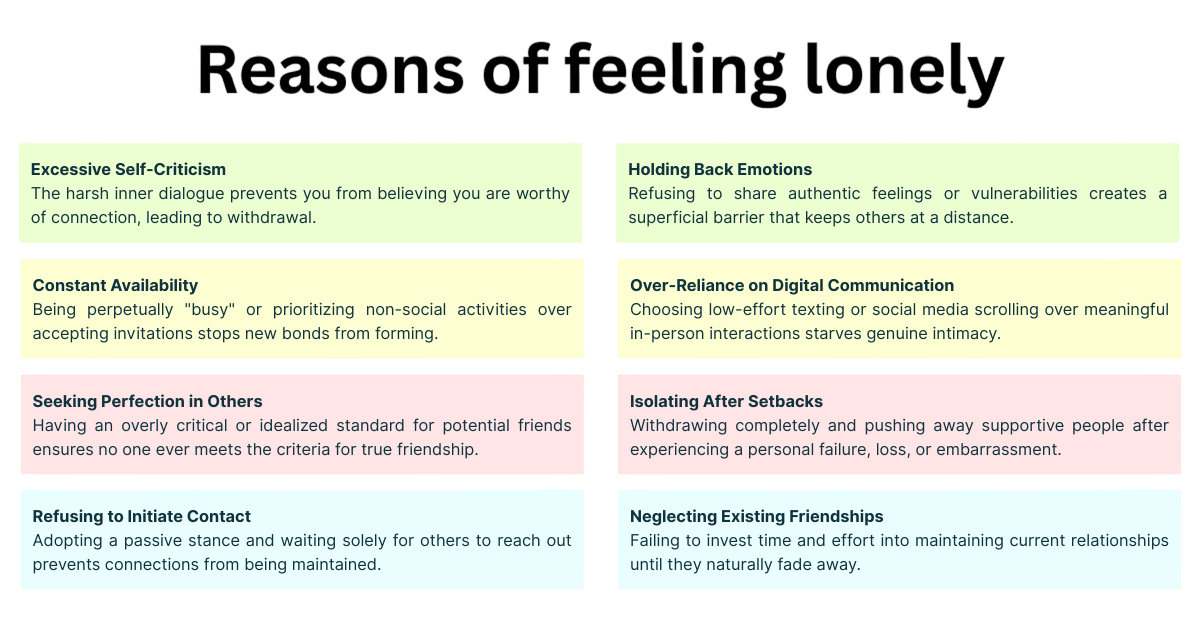
Humans are social beings. We are wired to interact, connect, and build relationships. But when we spend too much time in independent, self-contained activities, our ability to form long-lasting, meaningful relationships becomes weaker.
How to avoid being lonely
To avoid feeling lonely, you need to rebuild the habit of real human connection; slowly, intentionally, and consistently.
Start by integrating small shared moments into your daily life: talk to someone instead of texting, step out of your room for meals, join activities where people gather, and make conversation even when it feels slightly uncomfortable.
Loneliness fades not when you escape it, but when you replace isolation with genuine interactions, shared experiences, and emotional presence.
List of Things to do When Feeling Lonely
Here are 18 powerful things to do when you’re feeling lonely, backed by psychology, practicality, and real self-care.
- Journal your feelings
Write down exactly why you feel lonely. Often, identifying the root cause (e.g., feeling misunderstood, bored, or unmotivated) helps you address it easily.
- Engage in a deeply absorbing hobby
Do something that requires intense focus, like playing a musical instrument, solving a complex puzzle, or drawing. This replaces rumination with flow.
- Clean and organize your working and living space
Creating order in your external environment can often bring a sense of calm and control to your internal state.
- Engage in physical activity
Take a walk, stretch a little bit, dance to your favorite song; just move your body. Physical movement releases endorphins, breaks negative thought loops and is overall, a powerful mood regulator.
- Go to a public place
Work from a coffee shop, visit a nearby park or drive to a new neighborhood. Being physically around people, even strangers, reduces emotional isolation. You don’t have to talk to anyone, just be amongst others.
- Do one creative activity
Creativity is a powerful emotional outlet. Try:
- Drawing
- Writing
- Photography
- Cooking
- Designing something small
You’re not “filling time“, you’re reconnecting with yourself.
- Do a light self-analysis
This means gently asking yourself questions to understand what’s going on inside you, without judging yourself. Loneliness isn’t always caused by the lack of people; sometimes it comes from deeper emotional needs that aren’t being met.
- Get in touch with a friend
This doesn’t have to be a long or deep conversation. Even a simple message like:
- “Hey, just checking in. How have you been?“
- “Saw something that reminded me of you.“
Human connection, even in small doses, can immediately reduce feelings of isolation. You don’t have to share that you’re feeling lonely; just initiating interaction activates your social side and breaks emotional isolation.
- Do something you’ve never done
This helps your mind expand the horizon, develop new neural pathways and balances emotional stability.
- Try a 90-second rule emotional reset
Emotions physiologically last only 90 seconds unless your thoughts keep fueling them. Sit quietly and let the feeling pass without feeding it with thoughts.
- Listen to a guided mindfulness meditation session
There are many 5-minute meditations designed specifically to address emotional disconnection. They help you reconnect with yourself gently.
- Avoid digital entertainment
Digital entertainment like social media reels/shorts, posts and anything that gives false “validation” must be avoided. They will make you feel better in the short-term, but gradually they keep adding to the feeling.
- Join a community
Joining a group of people with similar interests helps you feel valuable and wanted. However, you must make sure that the community/group is supportive.
- Write down your goals
Pick up your journal or paper and write what you want to achieve in future. Be as detailed as possible. Write the challenges you can face if you start right now and their solutions.
Thankfully loneliness is not a permanent state. We were not born lonely; we learned the art of staying lonely. And, the thing we learned can be unlearned.
Just like a fever is your body’s way of telling you that a foreign element has entered your system, loneliness is also your mind’s way of telling you that you need connection, expression and emotional presence. The activities listed above aren’t meant to “fill time“, they’re meant to help you reconnect with your emotional self and the world around you.
When you consistently choose actions that bring clarity, movement, and connection, loneliness loses its power. You don’t need to do all things at once: even one small step can shift your emotional state and remind you that you’re not as alone as you feel.
Takeaways
- Loneliness is rarely about being alone; it’s about feeling emotionally disconnected.
- The biggest triggers of loneliness are consistent solitary habits and lack of shared experiences.
- Human connection must be rebuilt gradually through small daily actions.
- Physical movement, creativity, journaling, and social interaction are powerful emotional resets.
- Avoiding digital escape habits (like scrolling or gaming) prevents deeper emotional isolation.
- You can break the cycle of loneliness by intentionally choosing activities that activate connection, with yourself or others.
- One small action can dramatically shift how you feel, even if your situation hasn’t changed yet.
Subscribe to our newsletter.
Subscribe