

A habit is an activity that is repeated consistently until this action becomes fully automatic. Habits can form without a person intending to build them, but they can also be deliberately built or removed based on your needs and goals.
Example:
Brushing your teeth every morning after waking up: When you first started this behavior in childhood, you had to intentionally take this action. Put toothpaste on the brush, wet your mouth, and start brushing your teeth, but now it has become automatic.
- Cue: You wake up
- Action (habit): You brush your teeth
- Reward: Fresh, clean feeling in your mouth
You don’t think much about it, you just do it automatically. That’s what makes it a habit.
According to research at Duke University, habits form at least 40% of our daily activities. This makes habit an important aspect and essential for making progress in our overall life.
You’ll never change your life until you change something you do daily. The secret of your success is found in your daily routine.John C. Maxwell
How does a habit work?
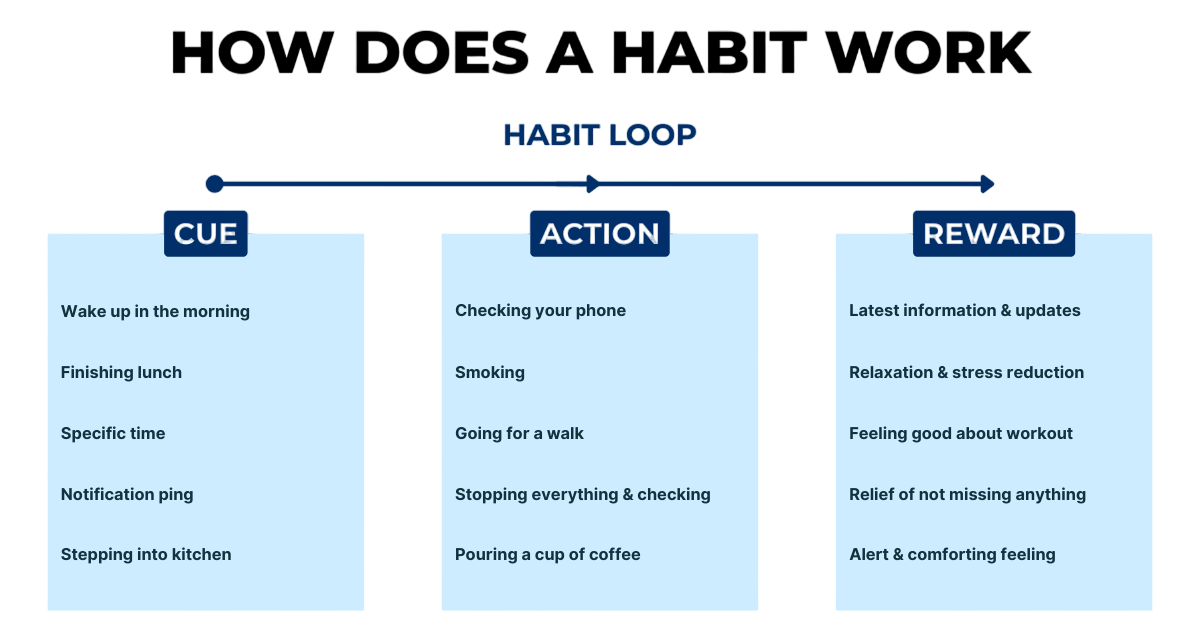
A habit works through a repeated cycle of cue -> action -> reward. This cycle is known as the habit loop.
Cue
The cue or trigger is something that acts as a reminder and tells your brain: ‘do this action now‘.
- Waking up
- Finishing lunch
- Feeling stressed
- A specific time
- Seeing your toothbrush
The cue starts the habit.
Action
This is the behavior that you start acting upon as soon as the cue is triggered. This action happens automatically without you thinking about it.
- Brushing your teeth
- Checking your phone
- Smoking a cigarette
- Drinking water
- Going for a walk
Reward
This is something that your mind loves. For this reason, your subconscious mind turned this action into a habit.
- A fresh mouth
- The dopamine hit from checking notifications
- Relaxation from smoking
- Feeling hydrated
- Feeling good after stretching
How does the habit loop get stronger?
Every time you repeat the cycle, your brain strengthens the neural pathway of this action, helping your mind memorize in a more efficient manner.
- You no longer have to think about taking this action. Your mind handles all this as soon as the cue is triggered.
- It becomes your default behavior until you work to change it.
- A habit saves an immense amount of mental energy as compared to doing the action intentionally.
Motivation is what gets you started. Habit is what keeps you going.Jim Ryun
How to build a habit?
Building a habit requires consistency. Here’s how you can create a completely new habit:
STEP 1 – START WITH A SMALL ACTION
Take a very small part of the ‘action’ that you want to become automatic, and repeat it daily. This action should be very light, requires a minimum amount of time and is extremely easy; so easy that you wouldn’t even say ‘no’ to it.
E.g., if you want to build a habit of book reading, start with reading one page or just one paragraph a day. That’s it.
STEP 2 – ATTACH A CUE ACTIVITY
Attach your habit to something you already do on a daily basis.
If you want to build this habit for the morning, just attach it to brushing your teeth. Start reading that one page or paragraph just after brushing every day.
This attachment (brushing your teeth) gradually starts to become the “cue” or trigger that we talked about earlier.
STEP 3 – USE A REWARD SYSTEM
Your brain will focus more on building better habits in an efficient manner if you reward yourself in some way. It can be anything that would provide your brain with dopamine. Every person has different ways to do that.
- Tea after reading
- Music after exercise
- A small break after completing a task
The value of rewards should reflect the difficulty of the activity. E.g., if you’re building a book reading habit, a reward of simple tea/coffee will suffice.
ADDITIONAL TIPS FOR CREATING GOOD HABITS
To make sure you stick to your actions on a consistent basis, make sure you prepare all the necessary items in advance. This reduces the resistance when the time comes and helps build discipline in the long term.
- Keep your book on your pillow
- Keep your gym clothes ready
- Keep water next to your bed
- Put your phone away from your hand
Less effort = more consistency.
First, we make our habits. Then our habits make us.John Dryden
Final Thoughts
Habits are not built through motivation. They are built through cues, small steps, rewards, and repetition. It takes at least four weeks to build a habit. During this time, you need to force yourself to do these tasks at the same cue or time.
If you wish to know more about building a new habit, read our guide on how habits shape your life.
